
Digital twins as a foundation for reliable cost calculations
Industrial companies are currently under enormous economic pressure. Fluctuating raw material prices, volatile supply chains, rising energy and production costs, and ever-shorter innovation cycles make reliable planning difficult. At the same time, customers expect precise quotations, short response times and maximum transparency throughout the entire value chain. In this environment, robust cost calculations are becoming a decisive competitive factor.
However, many companies still rely on static costing models or isolated data silos. Costings are often based on empirical values, outdated production data or manual assumptions. This increases the risk of inaccurate quotation calculations, insufficient margins or costly misjudgements in development and production. Traditional methods are increasingly reaching their limits, particularly in complex manufacturing environments.
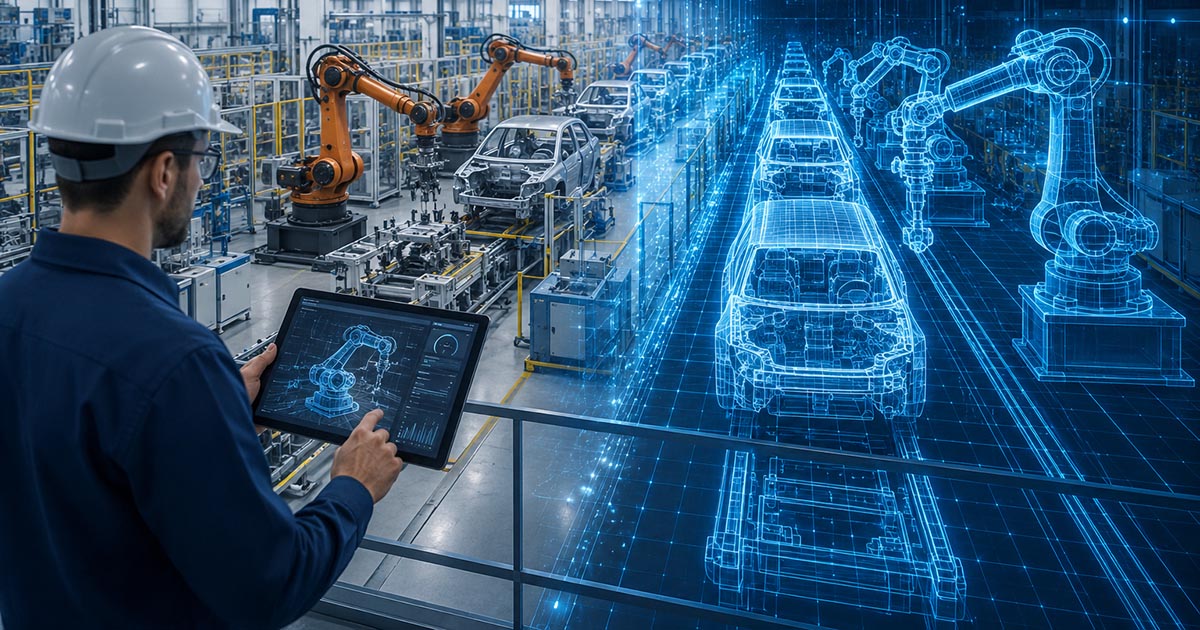
Digital twins open up new possibilities in this regard. By digitally modelling products, processes and production systems, real-world operations can be analysed, simulated and continuously updated on the basis of data. This provides companies with significantly more precise insights into cost structures, resource utilisation and potential risks.
When combined with professional costing software, this creates a robust foundation for well-founded cost calculations. Instead of relying solely on historical data, companies can simulate scenarios, assess changes at an early stage and dynamically adjust their calculations. This not only improves planning reliability but also paves the way for faster decision-making and sustained competitive advantages.
What are digital twins?
Digital twins are regarded as one of the key technologies of the digital industry. They enable companies to create virtual representations of real products, processes or entire production systems and to link these continuously with up-to-date data. This results in a dynamic digital model that reflects the actual state and behaviour of its real-world counterpart as accurately as possible.
Unlike traditional CAD models or simple simulations, a digital twin is not a static representation. Rather, data from various sources – such as ERP, MES, PLM or IoT systems – is continuously integrated and updated. The digital twin thus evolves in parallel with the real-world object and reflects changes in real time.
It is generally based on three key components: the physical object or system, the digital model, and the continuous data link between the two levels. This link enables companies not only to analyse the current state but also to simulate future developments. For example, production processes can be optimised, material usage assessed, or the impact of changes on costs, quality and lead times identified at an early stage.
In industry, digital twins are now used in numerous areas. These include, amongst others:
- product development and design,
- production planning and manufacturing control,
- predictive maintenance,
- supply chain management,
- and cost and profitability analysis.
Digital twins are becoming increasingly important, particularly in the context of complex manufacturing processes. They provide a unified, data-driven view of products and processes, thereby forming the basis for more precise decision-making.
The importance of reliable cost calculations in industry
For industrial companies, accurate cost calculations are far more than just a management tool. They form the basis for competitive quotations, stable margins and well-founded investment decisions. At the same time, the complexity of industrial value chains is constantly increasing. Material prices fluctuate at short notice, supply chains are highly sensitive to global events, and production processes are becoming increasingly diverse. This makes it increasingly challenging to calculate costs realistically and reliably.
Particularly in mechanical and plant engineering, as well as in the manufacturing industry, inaccurate cost calculations have a direct impact on profitability. Even small deviations in material, manufacturing or process costs can have a significant impact on project margins and delivery capability. Furthermore, many cost calculations are still based on historical experience or isolated individual assessments. Dynamic influencing factors are often overlooked in this context.
In practice, inaccurate cost calculations lead to several risks:
- Quotations are priced too low, jeopardising profitability;
- Safety margins reduce competitiveness;
- Production and development budgets are exceeded;
- Decisions are based on incomplete or outdated data.
At the same time, customer demands are increasing. Today, industrial customers expect not only attractive prices, but also transparent cost calculations, a high degree of planning certainty and rapid response times to changes. Companies must therefore be able to identify cost trends at an early stage and react flexibly to new conditions.
Reliable cost calculations provide a decisive advantage here. They enable a realistic assessment of products, processes and investments right from the early stages of a project. Furthermore, they improve the transparency of cost structures and support proactive management throughout the entire value chain.
How digital twins improve cost calculations
Digital twins lay the foundation for significantly more accurate and dynamic cost calculation. Whilst traditional costing models are often based on static assumptions and historical averages, digital twins enable the continuous analysis of real production and process data. This means that cost trends can not only be tracked more accurately, but also forecast at an early stage.
A key advantage lies in the integration of different data sources. Information from ERP, MES, PLM or IoT systems is fed into a single digital model, accurately representing products, manufacturing processes and resources as they actually exist. This creates a consistent data foundation for reliable cost calculations.
The following factors, in particular, improve the quality of cost calculations:
Real-time data improves the accuracy of cost estimates
Digital twins utilise up-to-date operational and production data. Changes in material consumption, machine running times, scrap rates or energy requirements become immediately apparent and can be incorporated directly into the cost calculation. This gives companies a much more realistic picture of their actual cost structures.
Scenarios can be simulated at an early stage
One of the key benefits of digital twins lies in their ability to simulate different scenarios virtually. For example, companies can analyse how rising raw material prices affect production costs, what impact process changes have on lead times, or how alternative manufacturing strategies influence profitability. This enables risks to be identified at an early stage and well-informed decisions to be made before any actual costs are incurred.
Transparency regarding complex cost structures
In modern manufacturing environments, costs often arise from the interplay of numerous factors. Digital twins make these interrelationships visible. For example, companies can identify which process steps are particularly cost-intensive, or how changes to product designs affect manufacturing costs and resource consumption. This offers a significant advantage, particularly in the early stages of development: cost optimisations can be identified and implemented even before production begins.
Faster and more flexible costing processes
Automated data flows and integrated models significantly reduce the manual effort involved in costing. Changes to products, materials or processes can be assessed almost in real time. This not only speeds up internal decision-making processes, but also improves responsiveness to customer enquiries and market changes.
When combined with professional costing software, this creates a seamless digital foundation for reliable cost calculations. Companies gain greater transparency, reduce uncertainties and lay the groundwork for economically sound decisions throughout the entire product life cycle.
Case studies: The use of digital twins in cost calculation
The benefits of digital twins are particularly evident in specific industrial use cases.
Manufacturing industry: Optimising production costs in a targeted manner
In the manufacturing industry, digital twins are frequently used to create virtual representations of entire production lines. Machine running times, material consumption, energy usage and scrap rates can be continuously analysed and simulated.
A typical example is the evaluation of alternative production parameters. Companies can simulate how changes to cycle times, different machine utilisation patterns or optimised material flows affect unit costs. This reveals cost-saving opportunities that often remain hidden in traditional costing models.
At the same time, bottlenecks or inefficient process steps can be identified at an early stage, before they result in actual additional costs.
Mechanical and plant engineering: More accurate quotation calculations
In mechanical and plant engineering, projects are often characterised by a high degree of customisation and long lead times. This makes it considerably more difficult to produce reliable quotations. Digital twins enable a significantly more accurate assessment of technical and economic implications right from the early stages of a project.
This means that designs, manufacturing processes and material usage can be simulated virtually before an order is carried out. As a result, companies gain more realistic estimates of manufacturing costs, production times, resource requirements and potential risks as the project progresses.
The outcome is more robust quotations, lower calculation risks and greater planning certainty.
Mass production: Assessing the impact of changes at an early stage
In mass production, even minor changes to products or processes often have a significant impact on costs. Digital twins help to analyse these effects at an early stage.
For example, companies can simulate how alternative materials affect production costs, what impact design changes have on processing times, or how new manufacturing strategies influence machine utilisation.
This makes cost assessment significantly more transparent and enables data-driven decision-making.
Consistent transparency throughout the value chain
Another advantage of digital twins lies in cross-organisational transparency. Cost-relevant data from development, procurement, production and management accounting is consolidated into a single digital model. This creates a consistent basis for costing throughout the entire product life cycle.
When combined with professional costing software, companies can analyse this data automatically and use it to produce more accurate estimates. This not only improves the quality of the cost estimates but also increases the speed and traceability of business decisions.
The role of professional costing software
Digital twins only realise their full potential when the underlying data can be collected in a structured manner, consolidated and analysed for business purposes. This is precisely where professional costing software comes into play. It combines technical and business information to form a robust basis for precise cost calculations and well-informed decisions.
In many industrial companies today, relevant data is spread across different systems. Production data comes from MES solutions, materials and procurement information from ERP systems, and technical product data from PLM or CAD applications. Without a central costing platform, data silos, data inconsistencies and manual effort arise, which can significantly impair the quality of cost calculations.
Professional costing software provides the necessary level of integration here. It enables different data sources to be consolidated and converted into consistent cost models. This results in transparent and traceable cost calculations throughout the entire product lifecycle.
Data quality as the basis for accurate calculations
Reliable cost calculations are only as good as the underlying data. Modern costing solutions ensure that up-to-date material prices, production times, machine costs and energy consumption are automatically incorporated into the calculation.
Thanks to direct integration with existing business systems, data can be continuously updated. This reduces the need for manual intervention and minimises sources of error.
Integration of ERP, MES and PLM systems
The strength of professional costing software lies, in particular, in the integration of different areas of the business. When ERP, MES and PLM data are linked to the digital twin, a seamless digital information base is created.
As a result, companies benefit from greater transparency regarding cost structures, consistent data across all departments, faster costing processes and better traceability of decisions.
This integration becomes a crucial factor for success, particularly when dealing with complex products and manufacturing processes involving a wide range of variants.
Automated and dynamic costing processes
Traditional costing processes are often time-consuming and heavily manual. Changes to bills of materials, production parameters or material prices often have to be updated manually. Professional software solutions automate these processes to a large extent.
In conjunction with digital twins, cost estimates can be updated dynamically as soon as relevant factors change. This provides companies with reliable information in near real time on: production costs, margin trends, the profitability of variants, or the impact of technical changes.
This improves both the speed and the quality of business decisions.
Competitive advantages through specialised software solutions
Whilst spreadsheets or isolated, stand-alone solutions quickly reach their limits, specialised costing tools offer scalable and audit-proof processes. They help companies to map complex interrelationships transparently and identify cost trends at an early stage.
For industrial companies, this means greater certainty in costing, faster quotation processes, lower costing risks and a sustainable improvement in profitability.
Professional costing software thus becomes the central link between the digital twin, production data and strategic cost management.
Economic benefits for industrial companies
The use of digital twins in conjunction with professional costing software offers industrial companies not only technological advantages, but above all measurable economic benefits. More accurate cost calculations, faster decision-making processes and greater transparency have a direct impact on profitability, competitiveness and planning reliability.
Particularly in a market environment characterised by rising cost pressures and the need for innovation, the ability to identify economic impacts at an early stage and manage them in a targeted manner is becoming a decisive factor for success.
Greater forecasting accuracy and lower costing risks
Digital twins enable a significantly more realistic assessment of products, processes and resources. Companies can continuously incorporate up-to-date production data, material costs and process parameters into their cost calculations.
This makes it possible to identify cost variances at an earlier stage, assess risks more accurately and safeguard margins more reliably.
Particularly in the case of complex projects or manufacturing processes involving a wide range of variants, the risk of miscalculations is significantly reduced.
Faster quotation and decision-making processes
In many industrial sectors, response speed and the quality of quotations are decisive factors in winning contracts. Through automated quotation processes and digital data models, companies can respond to customer enquiries much more quickly.
Changes to bills of materials, production parameters or material prices are taken into account immediately and assessed from a cost-effectiveness perspective. This shortens internal coordination processes whilst simultaneously improving the quality of quotations.
The benefits include a shorter time-to-quote, greater flexibility in meeting customer requirements and faster decision-making based on up-to-date data.
Effective reduction of production and development costs
By simulating different scenarios, companies can identify opportunities for optimisation at an early stage. For example, alternative materials, manufacturing strategies or process flows can be tested virtually before any real costs are incurred.
This brings inefficient processes to light, reduces unnecessary development costs, minimises scrap and rework, and ensures resources are used more efficiently.
This creates significant economic leverage, particularly in the early stages of development, as making changes at a later stage would be considerably more expensive.
Greater transparency throughout the entire value chain
Digital twins create a shared data foundation across different areas of the organisation. Development, procurement, production and management accounting can access consistent information and gain a better understanding of cost trends.
This transparency not only improves internal collaboration, but also supports strategic decision-making, for example in
Competitive advantages through data-driven management
Companies that can accurately calculate cost trends and manage them flexibly gain clear competitive advantages. They respond more quickly to market changes, calculate quotations with greater certainty and can control financial risks in a more targeted manner.
When used in conjunction with professional costing software, digital twins thus become a key component of future-proof, data-driven cost management in industry.
Best practices for successful implementation
For digital twins to realise their full potential in delivering robust cost calculations, companies need more than just the right technology. Clear objectives, a consistent data strategy and close integration between costing, production and IT are crucial. In practice, several approaches have proved particularly successful in this regard.
Start with clearly defined use cases
A common mistake is to roll out digital twins across the entire organisation straight away, without defining specific objectives. Successful projects, on the other hand, begin with clearly defined use cases where measurable business benefits become apparent quickly.
Suitable entry-level scenarios include, for example, optimising quotation calculations, analysing cost-intensive manufacturing processes, or simulating changes to materials and processes.
A focused approach at the outset helps to reduce risks and achieve initial results more quickly.
Closely integrating costing and production planning
Reliable cost calculations can only be produced when technical and business data are combined. Costing processes should therefore be closely linked to production planning, development and procurement.
Key success factors here include consistent master data, seamless data flows between ERP, MES and PLM systems, and shared data models across all areas of the organisation.
The better these areas are integrated, the more precise and dynamic the cost calculations become.
Ensuring data quality on an ongoing basis
The quality of the digital twin depends directly on the quality of the underlying data. Companies should therefore establish standards for data collection, maintenance and validation at an early stage.
Proven measures include automated data import from existing systems, regular plausibility checks and centralised responsibility for master data and process data.
High data quality not only improves the accuracy of cost calculations but also increases acceptance of digital cost calculation processes within the company.
Promoting interdisciplinary collaboration
The successful use of digital twins requires collaboration between different departments. Development, production, controlling, procurement and IT must work together to establish consistent processes and data structures.
Companies benefit in particular from clearly defined responsibilities, shared targets and the early involvement of all relevant stakeholders.
This not only leads to better technical solutions, but also to more efficient and economically sound decision-making processes.
Continuous optimisation rather than a one-off implementation
Digital twins are not static systems. Production conditions, markets and cost structures are constantly changing. Companies should therefore continually refine their models, data sources and costing logic.
Regular analyses and adjustments help to refine cost models, identify new opportunities for optimisation and ensure that cost calculations remain highly reliable in the long term.
Companies that implement digital twins strategically and in stages thereby create a robust foundation for data-driven costing and decision-making processes in industry.
Conclusion: Digital twins as the basis for future-proof cost calculations
Rising market demands, volatile cost structures and increasingly complex manufacturing processes are presenting industrial companies with new challenges in cost planning. Traditional costing methods are increasingly reaching their limits, as they are often unable to take dynamic factors sufficiently into account.
Digital twins bring a new level of transparency and forecasting capability to this area. The continuous integration of product, process and production data creates a robust foundation for analysing cost trends more precisely, identifying risks at an early stage and making data-driven business decisions.
Particularly when combined with professional costing software, this offers significant advantages for industrial companies. Automated data flows, integrated cost models and simulation-based analyses enable significantly more accurate cost calculations across the entire product life cycle. As a result, companies not only gain greater planning certainty but also increase their responsiveness and competitiveness.
At the same time, it is clear that the successful use of digital twins is not purely a technological issue. A consistent data strategy, integrated processes and a phased implementation with clearly defined use cases are crucial. Companies that meet these requirements lay the foundations for sustainable and future-proof cost management.
With the increasing use of AI-supported analytics and automated optimisation methods, the importance of digital twins will continue to grow in the coming years. Cost calculations will consequently become not only more precise, but also increasingly forward-looking and adaptive.
For industrial companies, this represents a decisive shift: away from reactive costing processes towards intelligent, data-driven management of costs, resources and profitability.
This article was created with the assistance of AI, and has been editorially reviewed and revised.

Future-proof costing with costing software from 4cost
The software and service solutions from 4cost provide you with a maximum of cost transparency at all phases. For improved cost control and increased profitability.
Request a commitment-free presentation now. Our experts will be happy to advise you on the right solutions for your company.