
Target costing in the trade-off between market price, ESG targets and technical feasibility
Three conversations, or variations thereof, that take place daily in industrial companies: The sales department reports that the target price for the new product range is eight per cent below the internal cost calculation. Asian competitors are making this possible. At the same time, the sustainability department is insisting that, from the next financial year onwards, all new products must be costed using a validated carbon footprint, as a major customer has made this a condition for awarding contracts. And the development team has indicated that, whilst the alternative material discussed at the last project meeting would be ten per cent cheaper, it is not technically feasible without compromising the product’s service life.
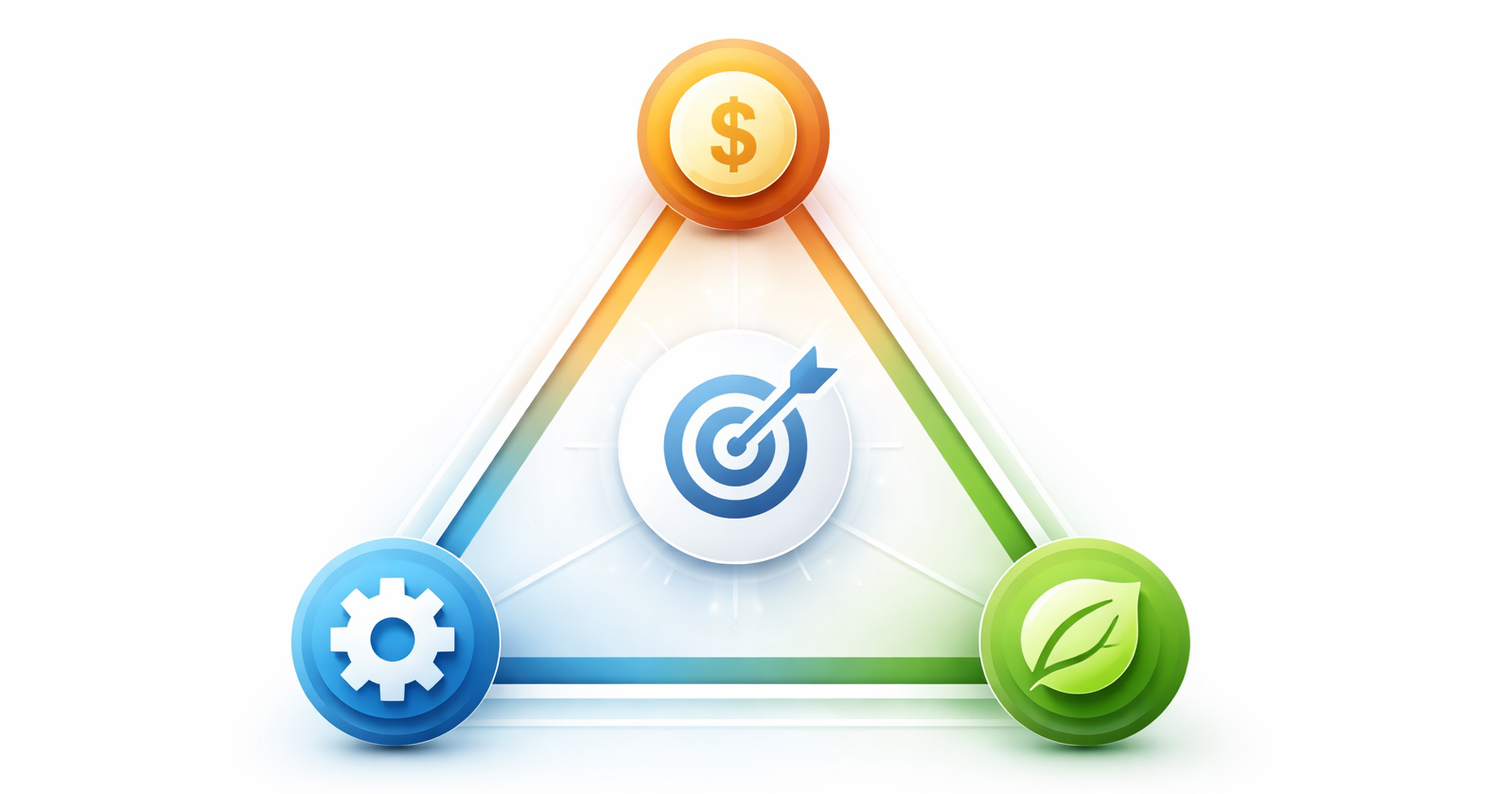
Three signals. Three constraints. And they all land on the desk of the cost estimators at the same time. What is described here as an example is no longer an exceptional situation. It is the new normal in industrial product controlling. Companies that develop and manufacture complex physical goods – whether in mechanical engineering, electrical engineering, the automotive supply industry or medical technology – are now faced with a ‘triangle of requirements’ that did not exist with such intensity just a few years ago: Market price pressure, ESG obligations and technical feasibility constraints are intertwined, reinforce one another and can no longer be addressed in isolation.
The obvious answer to precisely this ‘triangle of requirements’ has been the same for decades: target costing. And for good reason. The method was designed for precisely the situation in which internal aspirations and external reality diverge. It is not the question ‘What does it cost us to manufacture?’ that forms the starting point, but rather the question ‘How much can the product cost so that it can compete in the market?’ This shift in perspective from cost-driven to market-oriented costing is the method’s true promise, and it is a promise that has lost none of its relevance in a competitive environment. However, target costing was developed in a world where the market essentially dictated the price and costs consisted mainly of materials, manufacturing and overheads. That world no longer exists in this form.
The problem is that many companies still apply target costing today in the same way it worked twenty years ago. Using static costing models, manual Excel spreadsheets and sequential coordination processes between Controlling, Development and Procurement. The result is not robust target cost targets, but rather snapshots that will already be out of date by the time the next market shift or the next ESG regulatory change occurs.
This article is aimed at controllers, product managers and development managers in industrial companies who wish to understand target costing not merely as a costing method, but as a strategic management tool. It shows how the three areas of tension – market price, ESG and technical feasibility – operate in detail, where they influence one another, and what an integrated approach looks like that manages all three dimensions simultaneously.
Trade-off 1: The market price as a moving target
Volatility in global procurement markets
Target costing begins with a simple premise: the market price is known. It is the fixed point from which calculations are worked backwards. But what happens when this fixed point itself begins to waver?
Recent years have shown that market prices for industrial products are anything but stable. Steel prices that double within a year. Energy costs that render production cost calculations obsolete within a matter of months. Semiconductor shortages that drive up the cost of entire product ranges because alternative components result in completely different cost structures. And supply chain disruptions that not only drive up procurement costs but also lead times – and thus the planning horizons for the entire product costing process.
The structural problem here is not volatility in itself – price fluctuations have always existed. The problem is their speed and simultaneity. When raw material, energy and logistics costs come under pressure at the same time, a target cost based on a specific market price at a specific point in time loses its validity within weeks. Anyone who then continues to work with a static cost calculation is planning out of touch with reality.
Price pressure from international competitors and platform solutions
However, volatility is only one side of the problem. The other is structural in nature and more long-term: the persistent price pressure from international competitors, particularly from markets with lower wage and energy costs, and from the emergence of digital procurement platforms, which make it considerably easier for buyers of industrial goods to compare prices and thus force price transparency where previously there were opaque negotiating margins.
In terms of costing, this means that the achievable market price is not a fixed figure that can be derived once and for all from a competitive analysis. It is a flexible range that tends to shift downwards over time and can vary considerably depending on the customer segment, region and sales channel. A target costing system that is unable to reflect this differentiation will inevitably produce oversimplified results.
Added to this is an effect that is often underestimated in practice: platform-based procurement not only makes prices more transparent, it also accelerates price erosion. What is considered a competitive market price today may already be under pressure in twelve months’ time. Not because demand has changed, but because a new supplier has entered the market, using the platform as its primary sales channel and willing to gain market share with aggressive introductory prices.
Customer expectations versus realistic margin requirements: the target cost corridor in practice
In many industries, there is a gulf between what customers are willing to pay and the margins companies require; in recent years, this gulf has widened rather than narrowed. Target costing cannot bridge this gulf, but it can make it visible and thus lay the foundations for strategically sound decisions.
In practice, the concept of a target corridor has proven more effective than a rigid target cost figure. Instead of a single target, three scenarios are managed in parallel: an optimistic scenario based on the achievable premium price in the best customer segment, a base-case scenario based on the most likely market price in the core segment, and a conservative scenario that factors in the expected price pressure over the product life cycle.
This approach has a decisive advantage: it forces the controlling, sales and product management departments to engage in a joint discussion at an early stage about which scenario should form the actual basis for planning, and what consequences the choice of one scenario or another will have for product configuration, scope of equipment and technical specifications. What appears to be a matter of costing regularly turns out to be a strategic positioning decision.
Trade-off 2: ESG targets as new cost drivers and an opportunity for differentiation
What ESG actually brings to the calculation
In many industrial companies, ESG is still primarily situated within the corporate communications and investor relations departments. Sustainability reports are produced, CO₂ reduction targets are communicated, and governance structures are documented. What is often still missing, however, is the consistent integration of these targets into operational product costing – in other words, precisely where decisions are made regarding materials, suppliers, manufacturing processes and product configurations that determine a product’s actual environmental and social footprint.
This is currently changing, and faster than many those responsible for costing had anticipated. Three developments are driving this shift simultaneously:
Regulatory pressure: The European Supply Chain Due Diligence Act, the Corporate Sustainability Reporting Directive (CSRD) and the tightening of CO₂ pricing under the EU Emissions Trading Scheme are creating immediate cost realities that must be reflected in product costing. CO₂ has a price. Supply chain compliance has a price. And this price is no longer a theoretical figure in a sustainability strategy, but a concrete number in unit cost calculations.
Customer requirements: In the B2B sector in particular, major buyers – who are often subject to ESG reporting obligations themselves – are increasingly incorporating their sustainability targets into supplier contracts and procurement criteria. Suppliers who cannot provide a validated Product Carbon Footprint (PCF) are, in some sectors, simply no longer eligible to tender. ESG compliance is therefore no longer a differentiating factor; it is becoming a prerequisite for market entry.
Capital markets and financing: On the financing side, too, ESG is increasingly having an impact on operating costs. Companies with poor ESG ratings pay higher interest rates on borrowed capital, have limited access to certain investor groups and become less attractive to qualified specialists. These are indirect cost effects which, whilst difficult to attribute to individual product costings, are felt at company level.
The ‘ESG surcharge’ in the target cost model: an obligation, an investment or a competitive advantage?
The key question for costing is not whether ESG requirements incur costs, because they certainly do. The key question is how these costs are treated within the target cost model.
Three perspectives are encountered in practice, and they lead to fundamentally different costing approaches:
The first perspective treats ESG costs as a regulatory obligation, comparable to standardisation costs or certification expenses. They are recorded as an integral part of the manufacturing cost structure, reduce the available target cost corridor and must be offset by savings elsewhere. This view is conservative but honest: it recognises that ESG compliance ties up real resources without automatically generating a market price advantage.
The second perspective views ESG investments as a strategic positioning decision. Companies that invest early in low-emission manufacturing processes, recyclable materials or transparent supply chains create structures that, in the medium to long term, translate into lower regulatory risks, reduced CO₂ levies and more stable supplier relationships. From a costing perspective, this means that a higher proportion of ESG-related costs today can result in a lower present value of total costs over the product life cycle, provided the costing model reflects this time horizon.
Finally, the third perspective views ESG as an opportunity for price differentiation. In customer segments that actively demand sustainability performance and are prepared to pay a premium for it, a convincingly calculated and communicated PCF changes the starting point for price negotiations. The market price is then no longer a single figure, but a range differentiated according to ESG performance. Target costing must be able to structurally reflect this differentiation.
Which of these three perspectives is the right one? In practice, it is usually all three at the same time, depending on the product, customer segment and time horizon. A robust costing system must be able to switch between these approaches and present them transparently side by side.
Scope 1, 2 and 3 emissions in product costing
Anyone wishing to integrate ESG into product costing cannot avoid the question of which emissions are actually relevant to the calculation and what methodology should be used to assess them. The internationally recognised framework of the Greenhouse Gas Protocol distinguishes between three categories:
Scope 1 covers direct emissions from a company’s own manufacturing processes, such as those arising from the operation of furnaces, paint shops or vehicle fleets. These emissions fall within the company’s direct sphere of influence and can be measured with relative precision and factored into the cost calculation.
Scope 2 relates to indirect emissions from purchased energy, particularly electricity. Here, the choice of energy supplier and energy mix has a direct impact on a product’s calculated carbon footprint and thus on its ESG positioning in the market. Companies that switch to green electricity thereby directly alter the basis for their Scope 2 calculations.
Scope 3 is the most complex and computationally demanding category: upstream emissions from the supply chain as well as downstream emissions from the use and disposal of the product. In mechanical engineering and electrical engineering in particular, the largest proportion of a product’s CO₂ footprint is attributable to Scope 3 emissions – that is, to areas outside the company’s direct boundaries, for which reliable emissions data from suppliers is required.
This is precisely where the biggest data gap lies in practice. Supplier PCF data is often unavailable, non-standardised or out of date. Companies make do with industry averages or generic emission factors from databases, which are sufficient for an initial approximation but are not enough for a robust product calculation with external impact. The quality of ESG calculations therefore depends directly on the quality of supplier data – a problem that cannot be solved by improved calculation methods alone, but requires active supplier engagement in the area of ESG data transparency.
A tension within ESG: minimum social standards versus cost optimisation in the supply chain
ESG is not a monolithic objective. The acronym brings together environmental, social and governance requirements under one umbrella. These requirements may well conflict with one another in product costing.
The clearest example is the supply chain: consistent cost optimisation in procurement traditionally leads to low-wage countries and suppliers with the lowest overheads. However, minimum social standards such as fair wages, safe working conditions and the absence of child labour are not always guaranteed in these supply chains.
What this means for costing: compliance-compliant procurement from audited supply chains costs more. Not because the components are more expensive, but because audits, documentation requirements and, where necessary, changes of supplier generate real costs. Companies that do not factor these costs into their target cost calculations systematically underestimate their actual cost structure and risk either margin erosion or, in the event of a compliance breach, significantly more costly consequences.
At the same time, this creates a strategic tension that extends beyond costing: companies must decide to what extent they wish to actively position social supply chain quality as a product feature, and whether this added value can be successfully marketed in the relevant customer segment.
Trade-off 3: Technical feasibility as a prerequisite
The engineering limit: When target cost specifications become physically or technically unrealistic
Market price and ESG targets define what a product should cost and the environmental framework it must comply with. Technology defines what is actually possible. This third dimension of the trade-off is, in a sense, the most challenging, because whilst market prices are negotiable and ESG requirements can at least be adapted to some extent, physical and manufacturing constraints are non-negotiable.
In practice, this means that a target cost that appears mathematically sound on paper may simply be unachievable in practice because the required combination of performance parameters, material properties and cost level does not exist from a technical standpoint. A material that is intended to be lighter, stronger and cheaper than its predecessor is not always available. A manufacturing process intended to deliver greater precision whilst using less energy and incurring lower tooling costs is not always feasible. And a product architecture intended to be more modular, more robust and more cost-effective in terms of materials is not always designable.
The problem here is not that these limitations exist. The problem arises when target cost targets are set without sufficient technical validation, and it only becomes apparent late in the development process – or, in the worst case, after production has started – that they are unachievable. At this stage, the scope for corrections is minimal, whilst the costs of making changes are at their highest.
Early technical feasibility assessment is therefore not a downstream step in the target costing process. It is a prerequisite for target cost targets to be achievable in the first place.
Interplay between design, choice of materials and cost targets
Technical feasibility is rarely a simple matter – it is not simply a case of ‘possible’ or ‘impossible’. It is a question of interdependencies and conflicting objectives that only become apparent in the depths of the design process and which often escape the attention of the controlling department because they are expressed in a language understood primarily by engineers.
A typical example: the decision to switch a component from steel to aluminium in order to reduce weight and thus material costs sounds attractive from a cost calculation perspective. In the reality of design, however, it triggers a chain of consequences: altered wall thicknesses to compensate for reduced stiffness, adapted joining technologies due to differing thermal expansion, new surface protection requirements due to changed corrosion properties, and possibly a complete redesign of adjacent assemblies because the geometric boundary conditions no longer fit. What began as a cost saving often ends up as additional expenditure that more than offsets the original saving.
Systematically identifying these interactions and modelling them in the costing process is one of the key challenges in integrated target costing. Firstly, it requires the design department to be closely and early involved in the costing process – not merely as the recipient of target cost specifications, but as an active contributor. Secondly, it requires a costing structure that not only captures individual material costs but also makes visible the cost implications of design decisions across the entire product architecture: change costs, tooling costs, testing costs, and scrap risks.
In short: a costing process that evaluates design decisions in isolation systematically produces incorrect results. Interactions are not the exception; they are the norm.
Value engineering and functional cost analysis as a bridge between target costs and feasibility
When there is a gap between the target cost and the technically achievable cost, the question arises: how can this gap be closed? The classic answer in target costing is: through value engineering – the systematic analysis of the product to determine which functions it must fulfil, what these functions are worth to the customer, and which parts of the current design incur costs without delivering a proportionate benefit to the customer.
At the methodological heart of this is functional cost analysis: each function of a product is assessed in terms of its share of customer benefit and its share of total costs. Functions whose cost share exceeds their benefit share are candidates for redesign, simplification or elimination. Functions that are in high demand but are not being met to a commensurate degree are candidates for investment.
This approach sounds methodologically elegant but is challenging in practice. Firstly, it requires a clear definition of customer functions that goes beyond technical specifications and incorporates actual benefit assessments from the market. Secondly, it requires cost transparency at the functional level, which is often lacking in many companies because cost data is traditionally structured by component rather than by function. And thirdly, it requires an interdisciplinary approach, in which development, procurement, manufacturing and controlling work on the problem simultaneously rather than sequentially.
It is precisely this interdisciplinary approach that is the decisive factor for success. Value engineering, when carried out as an isolated controlling exercise without in-depth technical expertise, produces cost targets that are irrelevant to implementation. Value engineering, when conducted as a purely technical optimisation task without a market or costing perspective, optimises without taking customer needs into account. The bridge between target costs and feasibility is only built where both perspectives interact simultaneously and on an equal footing.
Agile product development and target costing: an iterative approach rather than linear planning
Traditional target costing follows an implicitly linear logic: the market price is analysed, the target costs are derived, the design is assessed against this target, and the result is checked to see if the target has been met. This linearity fits with a product development process that is itself organised linearly – requirements specification, design, detailed design, prototype, start of series production.
The reality of modern product development is increasingly different. Agile development methods, which originated in software development and are increasingly finding their way into the hardware sector, work with short iteration cycles, early prototypes and continuous feedback between development and the market. Requirements are not fully known at the outset, but evolve as the process progresses. And decisions on product architecture and material selection are not made once and for all, but iteratively.
What does this mean for target costing? It means that target cost targets can no longer function as rigid planning figures that are set at the start of a development project and then remain unchanged until series production begins. They must become dynamic control parameters that evolve in step with growing technical knowledge, changing market information and new ESG requirements.
This requires a costing process that is capable of iteration: one that does not necessitate a complete restart of the costing process every time an assumption is adjusted, but which can quickly run through scenarios, track changes transparently and flag deviations from targets at an early stage. In this model, the technical feasibility study is not a one-off hurdle at the outset, but rather an ongoing, accompanying process.
Resolving these tensions: Integrated target costing as the solution
From sequential to parallel processes: market, ESG and technical teams all around the table
The three areas of tension discussed above share a structural commonality: they arise not only from the complexity of the individual requirements themselves, but above all from the way in which companies deal with this complexity at an organisational level. Market price analysis is the responsibility of the controlling department. ESG assessment is the responsibility of the sustainability department. Technical feasibility studies are the responsibility of the development department. And in most industrial companies, all three operate sequentially, with time lags, based on different data sources and within different system environments.
The solution to this structural problem is not primarily methodological, but organisational: the transition from a sequential to a parallel process. Market, ESG and technical perspectives need not be incorporated into the costing process one after the other, but simultaneously. Represented by people who talk to one another, access the same data set and negotiate conflicting objectives together, rather than passing them on in the form of handover documents.
At first, this sounds like a plea for more meetings. In fact, however, it is a plea for fewer, but better-prepared, better-informed and more effective coordination sessions. The difference lies not in the frequency of communication, but in its quality. And quality in this context means one thing above all: that all those involved can look at the same up-to-date figures at the same time, rather than discussing different versions of different spreadsheets.
Scenario analyses and sensitivity models: What happens if a variable changes?
Integrated target costing does not mean that all uncertainties are eliminated. Market prices remain volatile. ESG regulations remain in flux. Technical options remain dependent on developments that cannot be fully predicted. What integrated target costing can and must do is to map these uncertainties in a structured way and turn them into information that supports decision-making.
The key methodological tool for this is scenario analysis, combined with sensitivity models that show how robust a target cost is to changes in individual input variables.
In concrete terms, this means that for every significant dimension of uncertainty – such as raw material prices, CO₂ prices, exchange rates, energy costs and regulatory requirements – defined scenarios are stored which, with a single click, affect the entire costing structure. The result is not a single target cost figure, but a range with associated probability weightings and options for action: What changes would need to be made to the design if the price of steel rose by twenty per cent? How would the margin change if the CO₂ price reached the level expected by regulators? Which alternative material becomes economically attractive under which price scenario?
These questions are not new. What is new is the ability to answer them systematically and with a reasonable amount of effort. Provided, that is, that the costing structure is designed in such a way that scenarios do not have to be recalculated manually, but can be adjusted parametrically. The difference between a company that reacts to a market change by launching a new round of costing and a company that can see in real time what this change means for its current product portfolio is a crucial one.
Sensitivity models also fulfil an important communicative function: they make conflicting objectives visible and quantifiable, which would otherwise circulate as qualitative assessments in coordination meetings without ever becoming a reliable basis for decision-making.
The role of real-time data availability: Why Excel-based calculations are structurally inadequate
At this point, it is inevitable to ask a question that remains an uncomfortable one in many industrial companies: What is actually used for costing? In the vast majority of cases, the honest answer is: Excel. Or a combination of Excel, ERP exports and in-house spreadsheet structures that have grown over the years, are maintained by a handful of key individuals, and whose logic is barely understood in full by anyone outside a small circle of insiders.
This is not a criticism of the people who work with these tools. Excel is a powerful tool, and the ingenuity with which those responsible for costing in industrial companies have mapped complex cost models within it deserves respect. But Excel has structural limitations that can no longer be overcome in the context of integrated target costing, with its three simultaneous areas of tension.
The first problem is data fragmentation: market price data comes from one source, supplier data from another, design data from the CAD system, and CO₂ factors from a database that someone updates manually. Consolidating all this data into an Excel model in a consistent, up-to-date and traceable form is less a costing task than a data maintenance task, and it ties up resources that are then lacking for the actual analytical work.
The second problem is version control: in a parallel process where the Controlling, Development and Sustainability departments are working simultaneously, the question ‘Which calculation is the current one?’ is by no means trivial. Who changed which assumption and when? Which version forms the basis of the latest approval decision? Can changes be traced and audited? In an Excel environment, these questions are structurally difficult to answer.
The third problem is scalability: a scenario model that combines three raw material price scenarios, two ESG regulatory scenarios and four design variants generates numerous calculation cases. When product configuration variants are added to this, the number quickly grows to a scale that can no longer be managed manually. What began as a manageable model becomes a maintenance nightmare; as a result, scenarios are no longer systematically run through the calculations but are replaced by empirical values. What sounds harmless is, in reality, the moment when a method ceases to be a management tool and becomes a mere documentation routine.
Requirements for a modern costing platform
What must a modern costing solution be capable of in order to actually enable integrated target costing given the complexity described? From a practical perspective, four requirements are key:
Firstly: integrability. A costing platform that operates as a standalone system alongside ERP, PLM and procurement systems does not solve the problem of data fragmentation; it merely shifts it elsewhere. Modern costing solutions must communicate in real time with the relevant upstream systems: bills of materials from the CAD system, purchase prices from the ERP, CO₂ factors from sustainability databases, and market price indices from external sources. Only when this data is updated automatically and at defined intervals is the data foundation created upon which reliable target cost analyses are possible.
Secondly: parametric modelling capability. The ability to construct cost models not as rigid sets of figures, but as parametric structures in which assumptions are explicitly stored as variable parameters, is the technical prerequisite for scenario analyses. If a change in the raw material price, the CO₂ factor or the unit quantity forecast is automatically propagated throughout the entire cost model and updates all dependent costing results, there is no need for manual recalculation – thereby eliminating one of the biggest sources of error in practice.
Thirdly: transparency and traceability. Costing results that cannot be traced are not trusted. A modern costing platform must provide comprehensive documentation of the assumptions on which a result is based, who changed which variable and when, and which costing version formed the basis for a particular decision. This auditability is not merely an internal quality requirement; in regulated sectors and for ESG reporting, it is increasingly becoming an external obligation.
Fourthly: visualisation and decision support. Costing results presented as tables of figures rarely have the necessary impact in interdisciplinary coordination meetings. Dashboards that visually present target cost ranges, scenario comparisons and variance analyses shorten the path from figures to decisions and lower the barrier for non-finance specialists, such as designers or development managers, to work with costing results. Übersetzt mit www.DeepL.com/Translator (kostenlose Version)
How professional costing software makes it possible to manage these three areas of tension
The four requirements outlined in the previous section are not merely an abstract ideal. They describe the functional core of what professional costing software can achieve for industrial companies today, and what constitutes the decisive difference between costing as a routine documentation task and costing as a strategic management tool.
In the context of market prices, this means, in concrete terms: rolling market price updates that are automatically compared against target cost targets; early-warning systems that flag up deviations before they lead to margin erosion; and scenario models that show how robust the current costing is in the face of defined market price changes.
In the context of ESG, this means: the ability to treat CO₂ costs as a regularly calculated cost item – not as a footnote in the sustainability report, but as an integral part of the manufacturing cost calculation. The ability to assess suppliers against ESG criteria and to incorporate this assessment into procurement decisions. And the documentation required for external ESG reporting and customer enquiries regarding validated PCF data.
In the context of technical feasibility, this means: a close link between the bill of materials structure and cost calculation, which translates design decisions directly into cost implications. The ability to run through material alternatives and manufacturing variants parametrically, without having to manually recreate each scenario. And a functional cost analysis based on the actual product structure, rather than on manually created approximation models.
The next step: from conflict to controllability
Market price pressures, ESG obligations and technical feasibility constraints are not going to disappear. They will intensify. This is due to further regulation, increasing competitive pressure and the growing complexity of industrial products. Companies that continue to tackle this triangle with sequential processes, fragmented data and manual costing models will not fail because they are using the wrong method. They will fail because their tools can no longer cope with the complexity they face on a daily basis.
The crucial question, therefore, is not whether integrated target costing is the right approach. It is. The crucial question is whether your costing infrastructure is currently capable of actually putting this approach into practice – with up-to-date data, parametric scenarios, ESG-integrated cost structures and a collaborative framework that brings Controlling, Development and Procurement onto the same data platform.
If the answer is no, now is a good time to change that. Get in touch with us. We’ll show you why professional costing software from 4cost is the enabler for future-proof target costing.
This article was created with the assistance of AI, and has been editorially reviewed and revised.

Target costing with professional costing software from 4cost
The software and service solutions from 4cost provide you with a maximum of cost transparency at all phases. For improved cost control and increased profitability.
Request a commitment-free presentation now. Our experts will be happy to advise you on the right solutions for your company.